

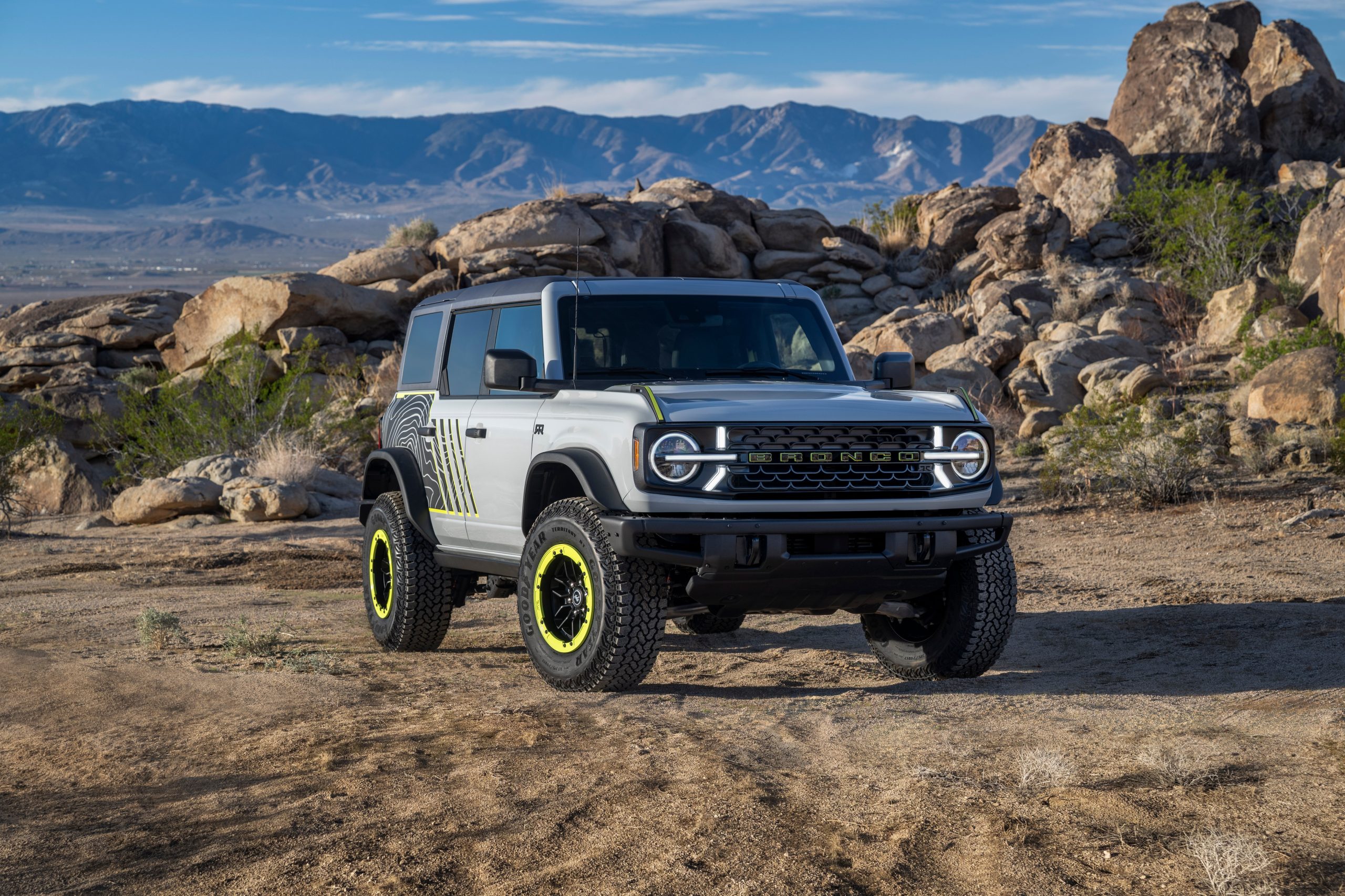
Few rivalries in the SUV world spark as much debate as this one. The Ford Bronco RTR and Toyota Land Cruiser come at off-roading from completely different angles. The Bronco RTR chases raw performance and trail-ready aggression, while the Land Cruiser leans on decades of heritage to deliver a refined, comfortable cruiser. If you’re weighing the 2027 Ford Bronco RTR against the 2027 Toyota Land Cruiser, understanding what separates them will help you make the right call, whether you’re running forest service roads near Mount Rainier or cruising gravel routes outside Olympia.
The Bronco RTR brings a sharp, purpose-built edge to this matchup. Developed alongside Vaughn Gittin Jr.’s RTR Vehicles and tested in California’s Johnson Valley, it’s engineered around off-road performance and driver excitement. The Land Cruiser leans into comfort, hybrid efficiency, and premium refinement instead. Both have devoted followings, but for buyers who prioritize capability over cushioning, the Bronco RTR makes its case the moment you grip the wheel.
Performance and Powertrain: RTR’s Adrenaline Advantage
Performance is where this comparison gets interesting fast. The Bronco RTR was never meant to be subtle, while the Land Cruiser pairs efficiency with power through its hybrid system. Both strategies have merit, but they serve very different drivers.
Ford Bronco RTR Power, Torque, and Drivetrain
Ford equips the Bronco RTR with a turbocharged 2.3L EcoBoost four-cylinder paired to a 10-speed automatic. Ford has not yet confirmed the RTR’s output, though the 2.3L produces 300 hp and 325 lb-ft in other Bronco models, so expect figures in that range pending Ford’s official numbers. Race-derived anti-lag turbo programming keeps throttle response instant coming out of loose terrain, and a high-capacity cooling fan borrowed from the Bronco Raptor helps the engine stay composed under sustained off-road load. Its advanced four-wheel-drive system includes an automatic on-demand mode that can be left engaged on pavement, sending power exactly where it’s needed on steep inclines and technical trails.
Standard high-clearance suspension and 33-inch all-terrain tires come on every Bronco RTR, and the optional Sasquatch package steps things up further with 35-inch tires, HOSS 3.0 suspension, FOX Internal Bypass dampers, and an electronic locking front differential. None of this is spec-sheet dressing; it’s hardware meant to take a beating on real trails.
Toyota Land Cruiser Hybrid Performance
The 2027 Land Cruiser uses Toyota’s i-FORCE MAX hybrid powertrain, combining a turbocharged 2.4L four-cylinder with an electric motor for 326 net combined horsepower and 465 lb-ft of torque. That’s a torque advantage on paper, and the electric motor delivers instant response off the line while the combustion engine handles sustained power needs. The result is a smooth, composed driving experience that works well in daily driving and moderate off-road situations, with meaningfully better fuel efficiency than the V8-powered Land Cruisers of the past.
The instant torque from the electric motor genuinely helps in slow-speed off-road scenarios, but the overall character of the powertrain is tuned for composed refinement rather than adrenaline. It’s a strong system for long-distance capability and reduced emissions, just not one built around aggressive trail performance the way the Bronco RTR’s is.
Off-Road Capability: Why the RTR Dominates the Trail
When the pavement ends, the Bronco RTR is clearly in its element. The Land Cruiser can still handle plenty on dirt, but its heavier, luxury-first build starts to show its limits once the terrain gets rough enough. For buyers who genuinely plan to tackle demanding terrain around Tacoma, Olympia, or the forest routes toward Mount Rainier, this part of the comparison matters most.
Suspension, Ground Clearance, and Approach/Departure Angles
The Bronco RTR’s suspension is built to absorb hard impacts and keep the wheels planted on uneven ground, with high-clearance geometry and 33-inch tires that let it clear rocks and ruts that would scrape a standard SUV. The optional Sasquatch package’s HOSS 3.0 suspension and FOX Internal Bypass dampers add even more articulation for climbing steep faces and descending sharp drops.
The Land Cruiser offers 8.7 inches of ground clearance with 32-degree approach and 22-degree departure angles, which is respectable and has improved in recent generations. Its suspension tuning still favors on-road ride quality, though, which brings compromises once terrain gets extreme. It handles moderate trails and light adventure driving, such as the gravel roads near Olympia, with confidence, but it isn’t calibrated for the same level of technical terrain as the Bronco RTR.
4×4 Systems and Terrain Management
The Bronco RTR’s terrain management system offers multiple dedicated drive modes tuned for sand, mud, rock, and normal on-road driving. Switching modes adjusts throttle response and traction settings to match the environment, letting drivers dial in exactly the right setup for whatever trail they’re tackling.
The Land Cruiser brings its own capable system through electronically locking center and rear differentials, Multi-Terrain Select, and Crawl Control for slow, precise maneuvering. It’s a reliable, well-engineered setup. Still, the Bronco RTR’s mode selection and Sasquatch-package hardware offer more granular control for dedicated off-road use, which is where the RTR’s advantage becomes clearest.
Technology and Infotainment Face-Off
Inside the cabin, the two vehicles take different approaches to technology. The Bronco RTR keeps things focused and functional, with Ford Co-Pilot 360 driver-assist features, a premium audio option, and a clean interface built around smartphone connectivity. Its controls are straightforward and geared toward an active buyer who wants easy access to the features they actually use.
The Land Cruiser leans into premium cabin technology, with Toyota’s suite of driver-assistance features, a 12.3-inch infotainment screen, and an available Head-Up Display. The interface is polished and responsive, matching its higher price point. Both systems suit their vehicles well: the Bronco RTR keeps tech practical and trail-ready, while the Land Cruiser treats it as part of a premium ownership experience.
Passenger Space and Cargo Capacity Compared
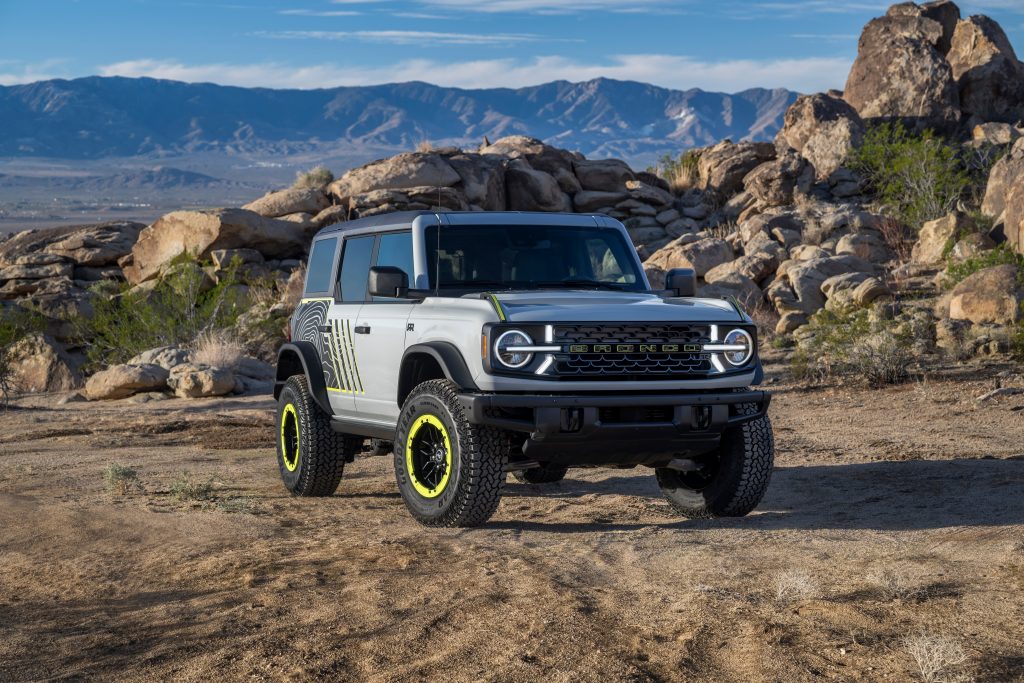
The Bronco RTR is built with active adventure in mind. It comes four-door only, seats up to five, and offers generous cargo space behind the second row (the four-door Bronco provides roughly 35 to 36 cubic feet, expanding to over 70 with the rear seats folded), enough for camping gear, mountain bikes, or recovery equipment on a weekend trip toward Mount Rainier. A washout interior with vinyl seats and Hyper Lime accents makes cleanup easy after a muddy trail day, while heated front seats and dual-zone climate keep things comfortable on the drive home.
The Land Cruiser takes a different direction. It seats five, offers 46.2 cubic feet behind the second row (up to 82 cubic feet folded), and provides 36.7 inches of rear legroom with 39.4 inches of rear headroom. Premium materials and supportive seating make it a genuinely comfortable long-haul vehicle.
If you want an SUV that doubles as a family hauler with off-road capability in reserve, the Land Cruiser delivers that balance. For pure adventure utility, though, the Bronco RTR’s layout is purpose-built in a way the Land Cruiser isn’t quite designed to match.
Which SUV Fits Your Lifestyle?
The honest answer is that these vehicles aren’t competing for the same buyer. The 2027 Ford Bronco RTR is built for people genuinely excited about off-road driving, whether that means running forest service roads outside Tacoma or tackling coastal trails on a weekend trip. It attracts buyers who treat the trail as the destination itself, and it typically sits at a lower price point than the Land Cruiser while delivering competitive, often superior, capability in the dirt.
The 2027 Toyota Land Cruiser is aimed at buyers who want long-haul comfort and hybrid efficiency along with off-road confidence, without committing to the Bronco’s trail-aggressive character. It’s a strong choice for families or travelers near Lakewood or Olympia who occasionally venture off-road but mostly value reliability and refinement. If that sounds like you, the Land Cruiser deserves serious consideration. But if you’re drawn to a factory-built off-road performer with real trail credentials that reward the person actually driving it, the Bronco RTR wins that conversation.
Schedule Your Bronco RTR Test Drive at Titus-Will Ford
Reading about specs only goes so far. Sitting in the driver’s seat and feeling what the Bronco RTR actually does tells you more than any spec sheet.
Why Test Drive With Us
- We’re one of the largest volume Ford dealers in Washington state, serving Tacoma, Olympia, and Lakewood.
- Our team has been helping buyers find the right Ford since 1938.
- We offer a full inventory of new Ford vehicles, transparent financing, and factory-certified service.
Visit or Contact Us
Located at 3606 South Sprague in Tacoma, WA, Titus-Will Ford is ready to help whether you’re set on buying or just want to get behind the wheel. Call our sales team at 253-356-8021, or contact Titus-Will Ford online. We’re open Monday through Friday from 9:00 AM to 8:00 PM, Saturday from 9:00 AM to 7:00 PM, and Sunday from 10:00 AM to 6:00 PM. The 2027 Ford Bronco RTR is worth experiencing in person.
Connect with us


