
The battle between the 2025 Ford Bronco and the 2025 Jeep Wrangler pits two off-road giants against each other in an all-American showdown. These rugged machines carry decades of terrain-conquering DNA and trailblazing history. If you’re a Tacoma adventurer looking to tackle Olympic Peninsula mud or Cascade Mountain trails, the choice between these two capable SUVs matters — and the differences might surprise you.
Engine Performance and Powertrain Options
The 2025 Bronco holds a 2.3-liter turbocharged four-cylinder engine that produces 300 horsepower and 325 lb-ft of torque. This base-level engine pairs with a 10-speed automatic transmission for extra smooth handling. The 2.7-liter twin-turbo V-6 engine delivers 330 horsepower and 415 lb-ft of torque, while the Raptor trim’s 3.0-liter turbo V-6 engine cranks out 418 horsepower and 440 lb-ft of torque. Tuned Raptor variants can reach an impressive 450 horsepower with 510 lb-ft of torque.
The Jeep Wrangler’s standard 3.6-liter V-6 engine produces 285 horsepower and 260 lb-ft of torque. You can choose between a six-speed manual transmission or an eight-speed automatic transmission. The 2.0-liter turbo-four engine delivers 270 horsepower with 295 lb-ft of torque, and the Rubicon 392 Final Edition is equipped with a 6.4-liter V-8 engine producing 470 horsepower and 470 lb-ft of torque.
Off-Road Capabilities: Where Legends Are Born
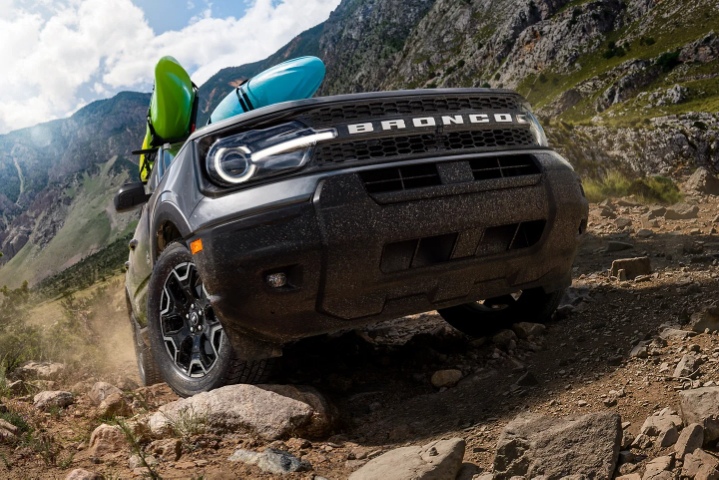
Ford’s G.O.A.T. Modes system, which literally means “Goes Over Any Terrain,” offers seven driving modes: Normal, Eco, Slippery, Sand, Mud/Ruts, Rock Crawl, and Baja. The Bronco delivers ground clearance of up to 13.1 inches, beating the Wrangler’s 12.9-inch maximum, with approach angles hitting as much as 47.2 degrees. It also wades through water with a depth of up to 37 inches — 3 inches more than the Wrangler’s 34-inch limit.
Jeep’s Rubicon trim offers 10.8 inches of ground clearance with approach angles of up to 44 degrees. The Xtreme Recon Package delivers 47.4-degree approach angles and 40.4-degree departure angles. The Rock-Trac and Command-Trac transfer cases provide solid four-wheel-drive performance, while an electronic sway-bar disconnect allows maximum wheel articulation on technical trails.
On-Road Driving Experience and Handling
The Ford Bronco wins hands down for daily driving comfort. Its independent front suspension makes highway trips and city driving more civilized, and although you won’t get sports-car handling, the Bronco feels more planted when traveling at high speeds. Its modern suspension reduces that tippy feeling over bumpy terrain, while maintaining ground clearance.
The Wrangler drives like a truck, with a bouncy, sometimes jarring ride, especially in two-door models. The four-door versions smooth things out a little, but you’ll still feel every bump. Those removable doors and tops create wind noise at highway speeds — the price you pay for that classic Jeep experience.
Interior Space, Comfort, and Practicality
The four-door Bronco offers 35.6 cubic feet of cargo space behind rear seats and 77.6 cubic feet with them folded. Passenger space in the four-door soft-tops is 108.2 cubic feet, with 36.3 inches of rear legroom. Legroom for front passengers in two-door Broncos is 43.1 inches, while rear passengers get 35.7 inches.
Jeep’s four-door Wrangler provides 31.7 cubic feet of space behind the back row and 72.4 cubic feet with all seats down (slightly less on the 4xe). Two-door models have 12.9 and 31.7 cubic feet of cargo space, respectively. Two-door Wranglers offer front legroom of 41.2 inches and rear legroom of 35.7 inches, while four-door models provide 38.2 inches of rear legroom. Both the Jeep and Ford vehicles feature materials that can handle muddy boots and wet gear. The Bronco, however, offers a more luxurious feel, with marine-grade vinyl available on some trims.
Technology and Infotainment Systems
The Bronco’s standard tech includes wireless connectivity to Android Auto and Apple CarPlay, Wi-Fi hot spot, Bluetooth, remote start, and a 12-inch digital dash (in higher trims) paired with a 12-inch touch screen running Ford’s SYNC 4 system. Ford’s over-the-air updates provide a future-proofing advantage, and household-style power outlets and wireless phone charging are a huge help on camping trips. There’s also a Bang & Olufsen 10-speaker setup available on higher trims for impressive sound quality.
Jeep’s Wrangler offers a 3.5-inch driver display, Wi-Fi, wireless Apple CarPlay and Android Auto connectivity, and a 12.3-inch touch screen with Uconnect 5. Optional features include a 7-inch digital gauge display, an Alpine 12-speaker audio system, and trail cameras for rock-crawling assistance.
Safety Ratings and Driver-Assistance Features
Ford’s Co-Pilot360 comes standard with forward collision warnings, automatic emergency braking, blind-spot monitoring, rear cross-traffic alerts, and a lane-keeping system. Adaptive cruise control is also available.
The 2025 Wrangler offers an advanced airbag system, electronic roll prevention, and stability control. Standard features include a backup camera and hill-start assist. Optional extras include adaptive cruise control, blind-spot warnings, and forward collision alerts.
Fuel Economy and Range Analysis
Nobody buys these off-roading vehicles for gas mileage, but it’s still a factor that matters. The most efficient Bronco is the base 2.3-liter turbo, which returns 20 mpg in the city and 22 mpg on the highway — perhaps not the most eco-friendly vehicle out there, but not too bad considering all the drivetrain components and rugged capability you’re getting.
The 2.7-liter V-6 engine’s numbers drop to 17/19 mpg city/highway, and from the Raptor trim, you can expect around 15 mpg in the city and 16 to 19 mpg on the highway, depending on its setup. Plan your gas budget accordingly for those weekend trips to Olympic National Park.
Jeep’s base V-6 engine with manual transmission gets 17 mpg in the city and 23 mpg on the highway — automatic transmission bumps that up by 1 mpg. The 2.0-liter turbo-four engine returns 20 mpg in the city and 22 mpg on the highway, while the fire-breathing V-8 engine burns premium gas at 13 mpg in the city and 16 mpg on the highway. The game-changer here is the 4xe hybrid model, with an EPA rating of 49 MPGe and 21 miles of all-electric range.
Towing Capacity and Utility Features
If you need to tow your boat to Lake Washington or Lake Chelan, most Broncos can easily pull anything weighing up to 3,500 pounds. Choose the Raptor trim, and that number jumps to 4,500 pounds, while the Wrangler Rubicon four-door model can tow up to 5,000 pounds when properly equipped. If you enjoy a Pacific Northwest adventure, both vehicles offer decent capability for hauling camping trailers or small boats.
Both options include recovery points and tow hooks on the front and rear, so you can get unstuck if needed. The roof and door removal systems allow you to enjoy those perfect summer days, though many owners find the Bronco’s setup more user-friendly for quick changes. Either vehicle includes accessory mounting points to add bike racks, cargo carriers, or extra lighting for those early morning fishing trips or late evening returns from mountain escapes.
Your Off-Road Adventure Awaits
While hardcore rock crawlers might prefer the Wrangler’s solid axle setup and its 500 pounds of extra towing power, for families who need a capable off-roader for weekend adventures and a smooth ride for everyday comfort, the Ford Bronco is the superior option.
Visit or contact us at Titus-Will Ford in Tacoma to schedule a test-drive and experience the 2025 Ford Bronco for yourself. Our friendly team is always happy to give you expert guidance for your Northwest adventures.
Connect with us


