
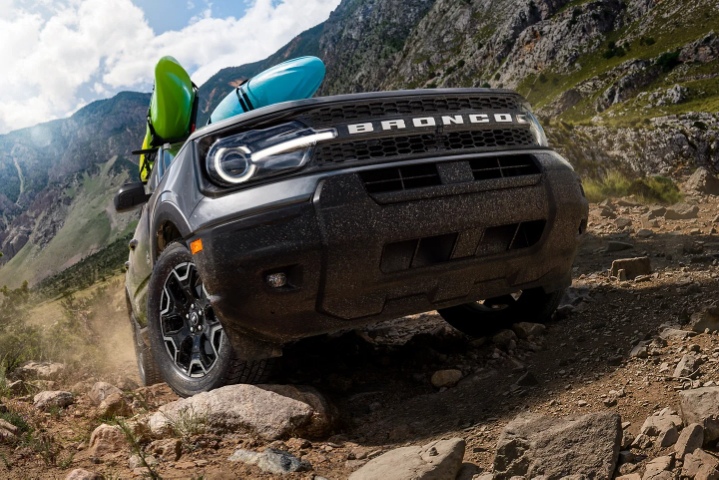
Choosing between the Bronco and Bronco Sport comes down to how far off-road you want to go. The Bronco is larger, has more power and a higher ground clearance, perfect for serious off-roading adventures into the Cascade Mountains. The Sport is smaller and is more practical and fuel-efficient, making it perfect for commuting and weekend camping trips to Dash Point State Park.
Design and Dimensions: Size Matters in Off-Road Performance
The Bronco comes in seven trims with two or four doors. A Ford Bronco costs $39,995 MSRP. Bronco’s rugged exterior, wide stance, and all-terrain tires give it an imposing stance. The removable roof and doors are perfect to enjoy the fresh air and brightness of Tacoma summers. Its body-on-frame design supports the engine, suspension, and drivetrain, making it ideal for serious off-road adventures and towing boats or campers on your Tacoma outdoor adventures.
Its ground clearance ranges from 8.3 to 11.6 inches depending on your trim and options. The Ford Bronco Raptor has the upgraded HOSS 4.0 system (High-performance Off-road Stability Suspension), raising the Raptor’s ground clearance to 13.1 inches, which allows you to tackle the most treacherous trails in the Capitol State Forest.
The Bronco Sport has a unibody design, integrating the body and chassis into one cohesive construction. Unibody designs use fewer parts and have a lighter weight, which makes the Bronco Sport a more efficient Tacoma commuter vehicle. With 8.8 inches of ground clearance and up to 23.6 inches of water-fording capability, you can take the Sport on adventures in Wildwood Park.
Interior Space and Passenger Capacity
All Bronco models seat four or five passengers. Four-door Bronco SUVs have 35.6 cu-ft of cargo space that expands to 77.6 cu-ft with the back seat folded, while the two-door has 22.4 cu-ft behind the back seat and 52.3 cu-ft with the seat folded. Every Bronco Sport has four doors and seats up to five passengers. Despite the Bronco Sport’s smaller overall dimensions, it has a generous cargo space of 33 to 65 cu-ft.
Performance and Capability: Where the Differences Shine
You have three engine options with the Bronco and two engine options for the Bronco Sport.
Engine Options and Power Output
Here’s a look at the engine options and power output:
| Bronco Engine | HP / Lb-Ft Torque | Bronco Sport Engine | HP / Lb-Ft Torque |
|---|---|---|---|
| 2.3-Liter I-4 | 300 / 325 | 1.5-Liter I-3 | 180 / 200 |
| 2.7-Liter V-6 | 330 / 415 | 2.0-Liter I-4 | 250 / 280 |
| 3.0-Liter V-6 | 418 / 440 | — | — |
Transmission and Drivetrain Systems
Both the Ford Bronco and Bronco Sport have standard 4×4 capability and either a seven-speed manual or a ten-speed automatic transmission. The Bronco comes standard with Trail Turn Assist, Trail Control, Trail 1-Pedal Drive, and AdvanceTrac with Roll Stability Control. Ford’s available HOSS systems provide confident driving and impressive handling in the harshest Tacoma environments, such as the Naches Pass Trail.
Off-Road Performance Capabilities
The Ford Bronco has excellent off-road performance capabilities, including:
- 37 inches of water-fording
- Up to 13.1 inches of ground clearance
- 47.2-degree approach angle
The Bronco Sport’s off-road specs are:
- 23.6 inches of water-fording
- Up to 8.8 inches of ground clearance
- 30.4-degree approach angle
Towing and Payload Specifications
The Ford Bronco can tow up to 4,500 pounds. Combine these figures with the cargo capacity, and the Bronco is your ideal companion on your Tacoma outdoor camping trips, hauling your boat and gear with ease. The Bronco Sport can tow up to 2,700 pounds with the Class II trailer hitch. That’s plenty of power to bring a small camper into the Washington wilds.
Fuel Economy and Efficiency
Bronco four-cylinder models with the automatic transmission have the best economy ratings of 20/22 mpg city/highway. The V-6 engine paired with the Sasquatch Package rates at 17/17 mpg city/highway. Bronco Sport models with the 1.5-liter engine get 25/30 mpg city/highway, and the 2.0-liter engine is rated at 21/27 mpg city/highway.
Technology and Interior Features
Bronco has a 12.0-inch infotainment touchscreen powered by Ford’s SYNC 4 operating system. The SYNC 4 OS has smartphone integration, letting you access your favorite podcasts, stream music, make calls, and more using intuitive voice commands. This hands-free capability lets you keep your eyes on the road or trail ahead instead of fumbling for controls.
The Bronco offers premium cloth or marine-grade vinyl upholstery that makes cleanup simple after a day off-roading with no doors or roof. Higher trims have signature upholstery like plaid inserts and leather-trimmed options. Bronco Sport focuses more on comfortable upholstery for daily driving, offering cloth, premium-trimmed, or leather-trimmed seats.
Both vehicles offer dual-zone climate control systems that let you adjust the temperature for ideal comfort, perfect for the various seasons. Bronco models have a rear climate control system that caters to your back seat riders.
The Bronco and Bronco Sport have plenty of practical in-cabin storage solutions. Bronco has an available MOLLE (Modular Lightweight Load-Carrying Equipment) strap system that fits on the back of the front seats. MOLLE has pouches, straps, and hangers to attach your smaller tools and equipment that enhance your outdoor activities like hiking in Mount Ranier National Park.
Safety and Driver Assistance
Ford’s Co-Pilot360 is a comprehensive suite of driver assistance technologies:
- Pre-Collision Assist with emergency braking
- BLIS Blind-Spot Information System
- Lane Keeping System
- Adaptive Cruise Control
- Evasive Steering Assist
- Automatic High Beams
- Rear-view camera system with parking sensors
Available Co-Pilot360 systems include:
- 360-degree camera system
- Reverse brake assist
- Front parking sensors
This standard suite instills confidence while navigating I-5 rush hour traffic. The available driver assistance systems help you navigate tight parking spots around Tacoma or tight trails in the Capitol State Forest.
Which One Should You Choose?
The serious off-road adventurer will want the Bronco and all its rugged equipment to tackle harsh terrain. A casual off-road enthusiast may prefer the Bronco Sport, especially if they plan to use it for daily commutes through the city. Consider what level of 4×4 capability you want and how often you intend to need it. If you need your vehicle for longer commutes, the Bronco Sport is the more economical option.
Test Drive the Bronco and Bronco Sport Today
Want to experience both vehicles before making a decision? Contact us to schedule a test drive or stop by our showroom and speak with one of our friendly, knowledgeable staff. They’ll answer your questions and let you take both SUVs for a spin.
Connect with us


